Few figures in history changed the world as dramatically as Genghis Khan. He built the foundation of the largest contiguous land empire in history, reshaped warfare across Eurasia, and left a legacy that still influences how historians understand conquest, leadership, empire, and state-building.
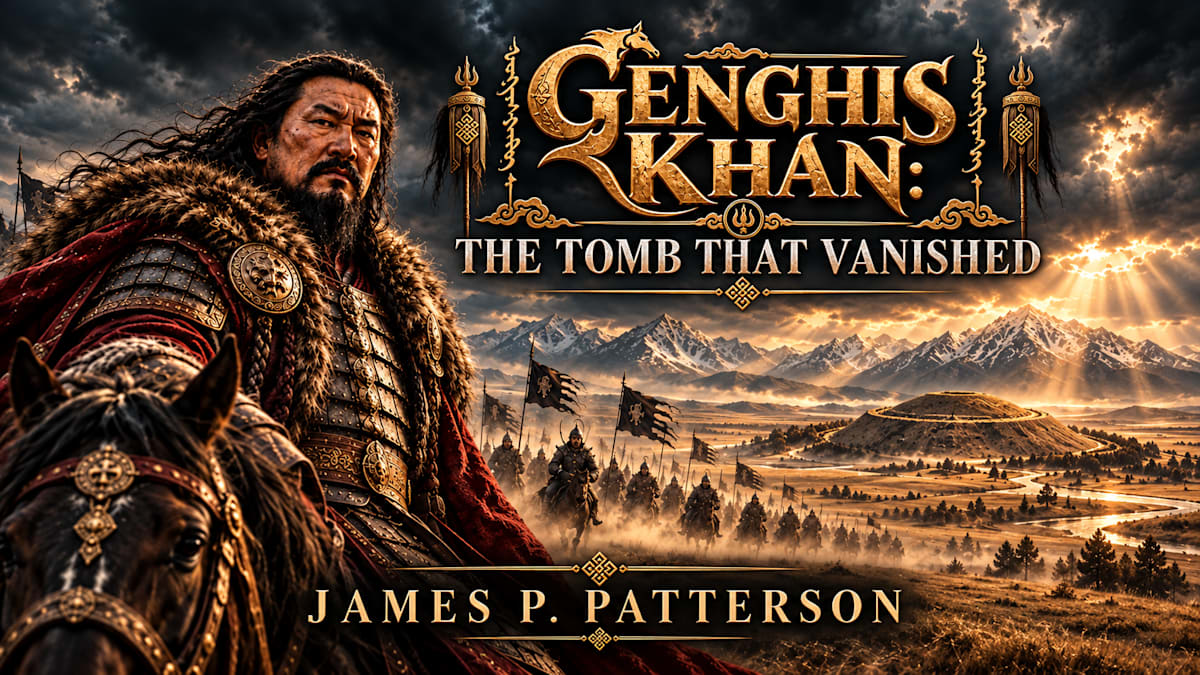
For all that is known about his life, however, one extraordinary question remains unanswered: Where is Genghis Khan buried? That mystery became the focus of my book, Genghis Khan: The Tomb That Vanished.
The Burial No One Has Found
Genghis Khan died in 1227, but the location of his burial was never recorded in a way that has allowed historians or archaeologists to identify it with certainty. Over the centuries, stories developed claiming that those who participated in the funeral procession were killed to protect the secret, that the burial site was hidden somewhere deep within the Mongolian landscape, and that the surrounding area was deliberately protected from intrusion.
Some of those traditions are difficult to verify, but the central mystery is very real. Despite centuries of speculation, exploration, and modern research, no universally accepted tomb of Genghis Khan has ever been discovered. That is remarkable considering the scale of the empire he created and the enormous impact he had on world history.
Why the Tomb May Have Been Hidden
The secrecy surrounding Genghis Khan’s burial may have reflected Mongol customs, political concerns, or a deliberate effort to protect the resting place of a ruler whose authority had transformed the steppe world. Unlike rulers who constructed enormous monuments to preserve their names, Genghis Khan may have been buried in a way intended to conceal the physical evidence of his grave.
That creates a fascinating contradiction. One of the most powerful men in history left behind an empire that stretched across continents, yet his final resting place may have been intentionally designed to disappear.
An 800-Year Search
For generations, researchers, archaeologists, historians, and explorers have tried to narrow down the possibilities. Historical records, oral traditions, archaeological surveys, satellite imagery, and other forms of remote sensing have all been used in attempts to identify potential burial sites.
The challenge is enormous. Mongolia is vast, and many of the areas traditionally connected with Genghis Khan remain remote, difficult to access, or culturally sensitive. There is also a serious ethical question surrounding the search itself, because some Mongolians believe that certain places associated with Genghis Khan should remain undisturbed.
That tension between discovery and preservation is one of the most interesting parts of the mystery.
More Than a Lost Grave
The search for Genghis Khan’s tomb is not simply about locating a burial chamber. It raises larger questions about how history is preserved, how legends develop, and how much of the past may still remain physically hidden from us.
If the tomb were ever discovered, it could potentially reveal extraordinary information about Mongol burial practices, material culture, political symbolism, and the world surrounding the early Mongol Empire. At the same time, the fact that no confirmed tomb has been found is part of what has kept the mystery alive for nearly eight centuries.
Why I Wanted to Investigate This Story
Historical mysteries like this are exactly why I created Forgotten Thrones Media LLC. I am fascinated by the places where documented history ends and unanswered questions begin.
With Genghis Khan: The Tomb That Vanished, I wanted to examine the evidence, the legends, the geography, the surviving historical accounts, and the modern search for one of the most elusive graves in history. The goal was not to pretend the mystery has already been solved, but to understand why it has remained unresolved for so long and why the search continues to fascinate historians and readers around the world.
Genghis Khan conquered kingdoms, changed the balance of power across continents, and became one of the most famous names in world history. Yet his final resting place remains hidden, making the mystery of his burial one of the most enduring unanswered questions of the medieval world.
For now, the tomb that vanished remains exactly that: a mystery still waiting for an answer.
Genghis Khan: The Tomb That Vanished is available now through major book retailers.
James P. Patterson
Founder, Forgotten Thrones Media LLC
Author • Digital Historian • Creator of Forgotten Thrones TV