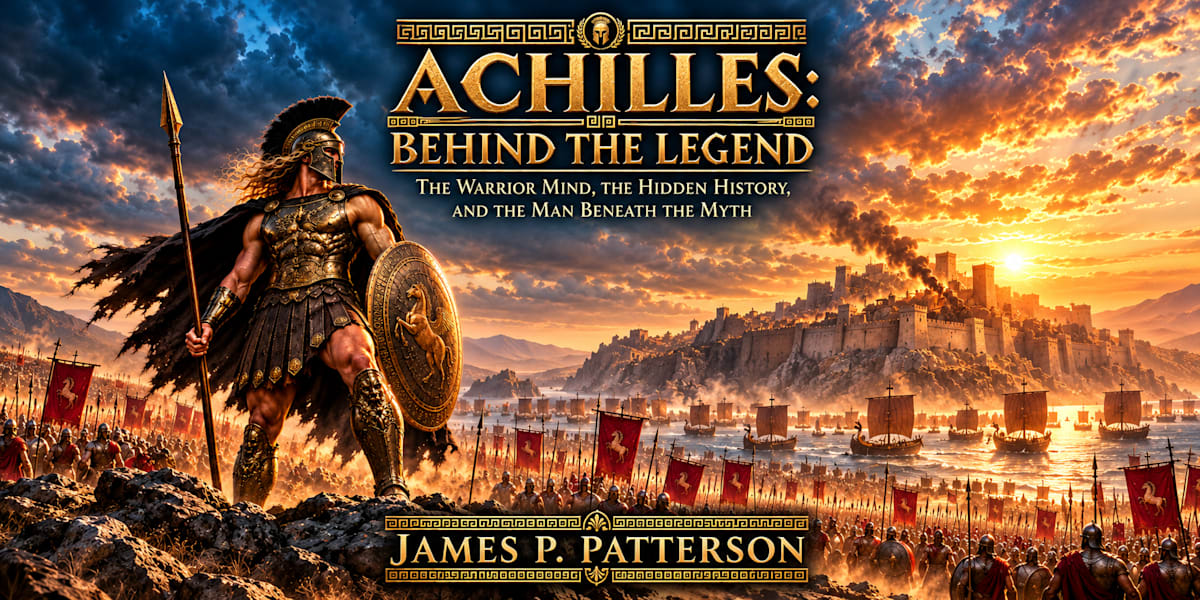
Yesterday marked another major milestone for Forgotten Thrones Media with the release of my 33rd published book, Achilles: Behind the Legend: The Warrior Mind, the Hidden History, and the Man Beneath the Myth. Achilles is one of the most famous warriors in history, but he is also one of the most misunderstood. For thousands of years, his name has become synonymous with strength, invincibility, rage, glory, and the famous weakness that supposedly brought him down. Most people know the Trojan War, the names Hector and Patroclus, and the story of the heel, but the Achilles most people recognize today is the product of centuries of mythology, literature, reinterpretation, and popular culture.
This book was written to go deeper than the familiar legend. Rather than simply retelling the Trojan War, Achilles: Behind the Legend examines the warrior behind the story and asks a more difficult question: what actually made Achilles so extraordinary? The book explores his combat ability, warrior mentality, relationship with honor, understanding of mortality, and the psychological forces that shaped many of his most important decisions.
More Than the Story of the Trojan War
Achilles has long been remembered as the greatest warrior among the Greek forces at Troy, but his importance goes far beyond battlefield skill. He is one of the most complex figures in the ancient heroic tradition because he is defined by contradiction. He could demonstrate extraordinary courage and discipline in combat while allowing anger to consume him outside it. His reputation mattered enormously to him, yet his pursuit of honor repeatedly brought devastating consequences. He could be ruthless toward his enemies while showing deep loyalty and emotional attachment toward those closest to him.
That complexity is one of the reasons Achilles has remained such a powerful figure for thousands of years. The book examines his relationship with Patroclus, his confrontation with Hector, his encounter with Priam, and the devastating grief that follows the death of his closest companion. These moments reveal that Achilles is far more than a warrior defined by physical strength. They show a man struggling with rage, loss, pride, loyalty, reputation, and mortality.
The goal of the book is not to strip away the legend of Achilles. The goal is to understand how that legend was created and why it survived.
The Warrior Mind of Achilles
One of the central themes of this book is warrior psychology. Ancient warfare demanded far more than physical strength, and warriors operated in a world where reputation, honor, fear, loyalty, rage, and social expectations could be just as influential as weapons and armor. Achilles represents an extreme version of that warrior mentality because the same intensity that helped make him extraordinary in battle could also become destructive when turned inward.
His anger shapes much of the action in Homer’s Iliad. His withdrawal from battle affects the entire Greek war effort, and his grief over Patroclus transforms him once again. When Achilles returns to combat, his behavior reflects a man no longer motivated only by victory or honor, but by loss, rage, and the need for vengeance. His confrontation with Hector becomes one of the most famous clashes in ancient literature, yet some of the most revealing moments involving Achilles occur away from the battlefield, when the warrior is forced to confront grief, mortality, and the consequences of his own choices.
Those moments are important because they reveal the man beneath the warrior.
Homer’s Achilles and the Achilles We Know Today
One of the most important parts of researching Achilles is separating the earliest surviving traditions from the stories that developed later. Many people immediately associate Achilles with the River Styx and the famous vulnerable heel. Those stories have become inseparable from his modern identity, but they are not central features of Homer’s Iliad.
The Achilles presented by Homer is not simply an invulnerable superhero with a single physical weakness. He is a warrior confronting mortality, reputation, grief, rage, and the knowledge that the path toward eternal fame may require an early death. That distinction matters because it changes the way we understand the character. The warrior who knows he can die is far more compelling than the warrior who believes he cannot.
The book examines how later traditions changed and expanded the Achilles story, and how those additions shaped the version of Achilles that survives in popular culture today. By comparing the earliest literary traditions with later mythology, we can better understand how one of the ancient world’s most famous heroes gradually became something larger than the original stories.
Myth, History, and Bronze Age Warfare
Another major focus of Achilles: Behind the Legend is the historical world behind the story. The Trojan War occupies a fascinating position between mythology and history because archaeology has shown that Troy was a real place, while many of the specific events described in the epic tradition remain impossible to confirm.
That raises important questions. Was there a Trojan War resembling the one preserved in Greek tradition? What can archaeology tell us about the city of Troy? What would warfare during the Late Bronze Age actually have looked like? How closely do Homer’s descriptions reflect the world in which a historical warrior such as Achilles might have fought?
These questions move the discussion beyond mythology and into the fields of Bronze Age warfare, archaeology, ancient Greek history, heroic tradition, and military culture. There may never be enough surviving evidence to prove that Achilles existed exactly as Homer described him, but that uncertainty is part of what makes the subject so compelling. Achilles stands directly on the boundary between history and legend, and that boundary is where some of the most interesting questions begin.
Why Achilles Still Matters
Some historical and legendary figures disappear when the civilizations that created them disappear. Achilles did not. His name survived the collapse of the Bronze Age world, the rise and fall of Greek city-states, the Roman Empire, the medieval period, and into the modern world. Writers continued to reinterpret him, artists continued to depict him, and audiences continued to return to his story.
Even the expression “Achilles’ heel” remains part of everyday language thousands of years after the world that created his legend disappeared. That level of cultural survival is extraordinary, and it tells us that the story of Achilles has always represented something larger than a single warrior or battle.
Achilles endures because his story deals with themes that remain deeply human. Glory, rage, loyalty, grief, pride, fear, reputation, and mortality are not limited to the Bronze Age. They are part of the human experience, and they are among the reasons Achilles continues to matter.
Book Number 33
The publication of Achilles: Behind the Legend also represents another personal milestone because it is my 33rd published book. When I began building the Forgotten Thrones catalog, the goal was never to write one or two books and stop. I wanted to create a growing library dedicated to history, warriors, ancient civilizations, historical mysteries, psychology, and the unresolved questions left behind by the past.
Achilles fits naturally into that mission because, like many of my books, it begins with a familiar story and then starts asking questions. What came from Homer? What appeared later? What fits the historical world of the Bronze Age? What does archaeology tell us? What does mythology reveal about the people who preserved these stories? What happens when we stop looking at Achilles only as an untouchable legend and begin examining him as a warrior facing choices, consequences, anger, loss, fear, and mortality?
Those are the questions at the heart of this book.
The Man Beneath the Myth
The legend of Achilles has survived for thousands of years because it is about far more than combat. It is about the cost of glory, the destructive power of rage, the strength of friendship, the devastation of grief, and the desire to be remembered. Most importantly, it is about the choices a person makes when he understands that those choices may determine how he will be remembered long after he is gone.
That is the Achilles I wanted to investigate in this book. Not simply the hero. Not simply the myth. The man beneath it.
Achilles: Behind the Legend: The Warrior Mind, the Hidden History, and the Man Beneath the Myth is now available on Amazon.
James P. Patterson
Founder, Forgotten Thrones Media LLC
Author • Digital Historian • Creator of Forgotten Thrones TV